In the earlier stage of this unit, my work mainly focused on critiquing and exposing the patriarchal moral framework, gender bias, and male gaze within mainland China. I started from the judgements of women within censorship systems, and looked into the judicial suppression faced by feminist movements. Because I wanted to reveal issues operating at a broader political level, I selected texts from social movement archives as design materials. Many of these texts were first-person testimonies describing experiences of political violence. Larger structures of power and control are revealed through individual memories and struggles—such tension made these accounts especially powerful. What those testimonies reveal, as well as the obstacles to their circulation, demonstrates how patriarchal moral frameworks have been legitimised through legal systems and mechanisms of censorship; they function as proxies for “proper” discourse, determining what is speakable and what must remain silent.
Such violence exists not only in those public social events, but also permeates everyday life in less perceptible forms. It may be embedded in family relationships, school life, and the workplace, from one’s family members, teachers, co-workers……and others with whom people interact daily. These experiences are often smaller, more fragmented, and easier to overlook. But if they are brought together, could they collectively form a broader picture that reveals shared patterns and structures of patriarchal discourse? Therefore, collecting and compiling personal narratives of these experiences became the starting point of my next project.
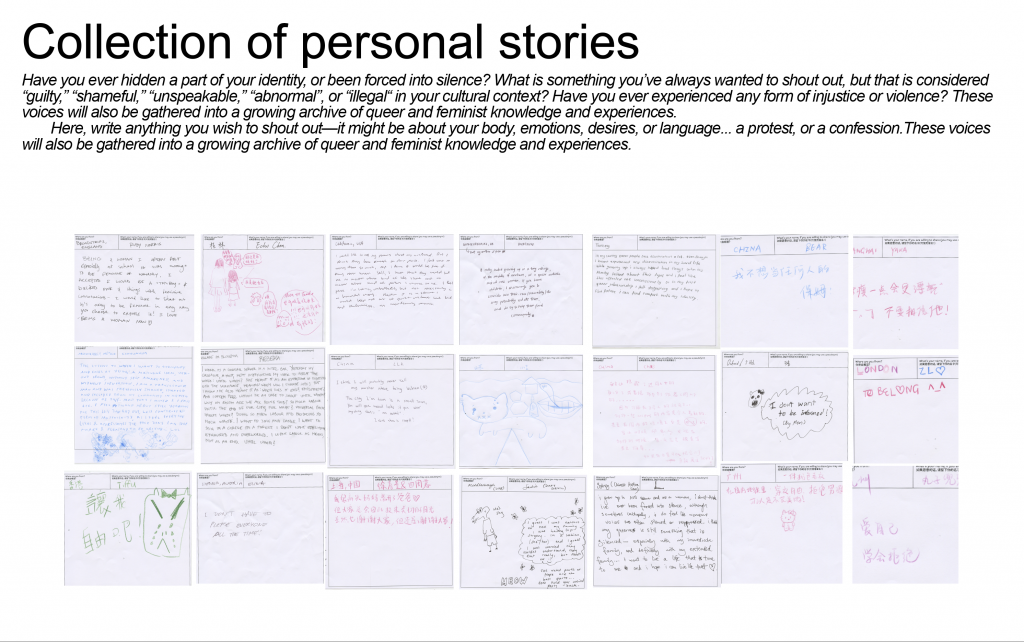
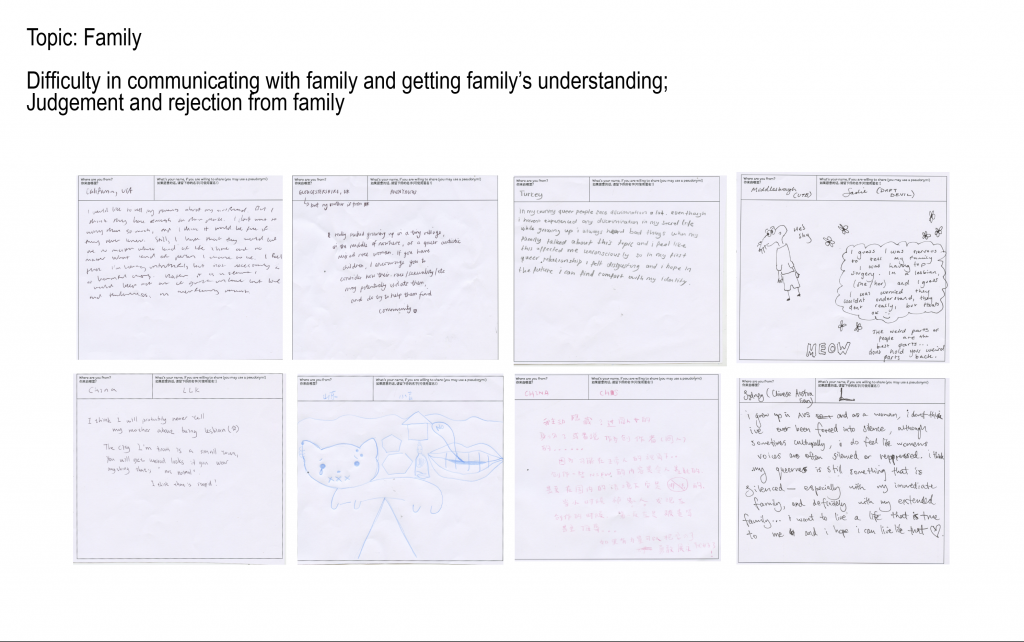
My initial plan of this project was to use surveys to collect and compile “things people are not allowed to talk about,” “repressed voices,” “forced silence,” and “forced disappearance.” Through handwritten questionnaires, I received many vivid and emotionally rich responses. After that, I considered approaching strangers on the street and asking them to fill out handwritten questionnaires, but this approach felt somewhat random. I also thought about whether the design itself could become an interactive device for “collecting responses” that could be placed in public spaces, or perhaps a setting within an exhibition where audiences could fill in content and publish it in some way. But after thinking more carefully about it, I realized that I still wanted to focus on making publication itself, rather than the tool used to produce participation.
In addition, the participants involved in the earlier survey came from very diverse backgrounds and cultural contexts, which meant that the collected content are relatively broad and generalized. My work has been rooted in the context of mainland China and I felt there were still many aspects of this context that I had not yet addressed fully. Therefore, I think I could explore these issues in greater depth and produce content that is more specific and thus more meaningful.
The earlier surveys were also conducted mainly among audiences already familiar with independent publishing. However, publishing is ultimately about connecting with more people and creating dialogue with a broader public, communicating things to a wider range of audiences. I mentioned this in my previous audience engagement reflection: the significance of publishing lies in its outward expansion, its ability to circulate, and its potential to create connections between people. Therefore, if the project remains only within art and design world, speaking mainly to people already familiar with publishing, its impact may remain limited. Considering the suppression, control, censorship, and stigmatization surrounding independent publishing within mainland China, I began to feel that perhaps a more meaningful direction would be to expand people’s understanding of publishing itself as a medium. Because of this, I wanted to challenge myself to engage with broader groups of people, including those outside the art and design world. This also required me to understand how people unfamiliar with art and design think about these issues.
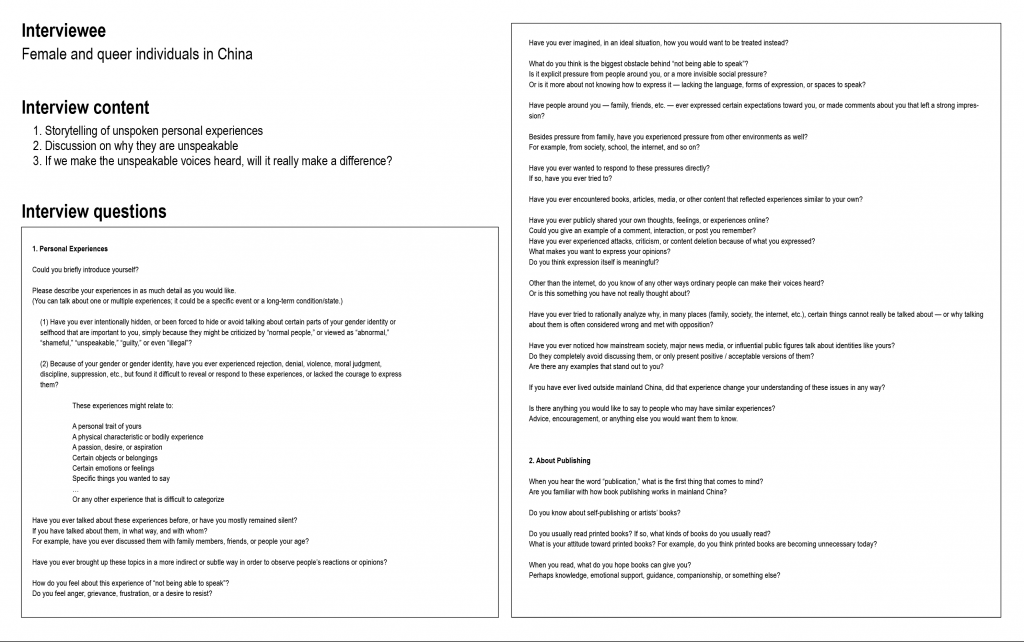
I expanded the original topic, developed a more detailed set of interview questions, and conducted a series of in-depth voice interviews with several women and queer individuals living in mainland China, who are less familiar with the fields of art and design. The interviews included sharing of personal experiences, reflections on patriarchal discourse and personal expression within the Chinese-speaking context, and their understanding of publications and publishing.
For the responses collected earlier through the surveys, I plan to reorganize and present them in the form of small comics, but perhaps that will become another story.
Leave a Reply