Where should I begin with the visual experimentation? I struggled with this question for quite a long time.
My starting point was simple: to materialize the silenced voices, to allow them to exist physically that can be preserved and circulated. I believe that the act of collecting these voices in written form, and placing them within a printed medium, already achieved the aim of making them visible. But this is only about material existence and the medium itself, and I need to do further than this. What I had not yet considered was their more specific visual form: the graphical language, representational strategies, shapes, textures, and visual structures, etc., through which these voices could be amplified and perceived more straightforwardly.
According to the feedbacks from tutorial, I could give each interviewee a stronger sense of individuality—for example, through different typefaces, folding methods, layouts, and other visual elements. I started thinking about ways to approach this, and I became interested in using metaphor.
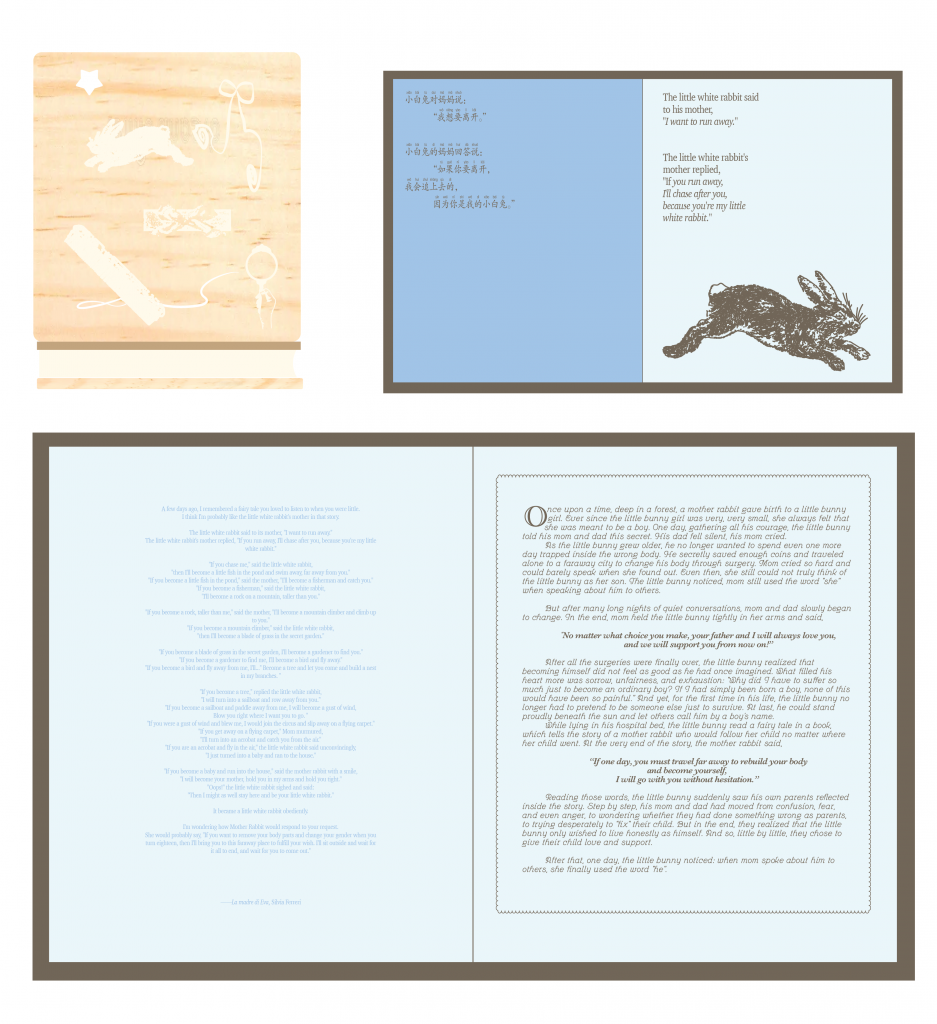
One interviewee particularly impressed me. While talking about how his mother gradually came to accept his queerness, he mentioned a fairy tale he once read about a little rabbit and his mother. I was deeply moved by this story, and I started to feel that the form of the fable itself carries a kind of queerness — a queer mode of resistance. Many people are constantly hiding or performing: as camouflage so that they could survive in the “normal society”, as self-discipline to “correct themselves”, or as a way of approaching an identity that they are difficult to realize in reality. At the same time, these experiences are the “unspeakable” parts within patriarchal discourse, speaking them often requires some form of concealment or disguise. In this sense, fables feel like a queer survival strategy.
This directly inspired me to experiment with a visual language based on fables. In this approach, the enquiry would be more toward translation as a process of transmitting, retelling, and re-narrating stories, in which I explore how me as a narrator can retell the stories I have heard. This also connects to methods I used in the previous semester—using a metaphorical carrier to deliver sensitive information, and more directly intervenes in questions surrounding censorship and linguistic control.
At the same time, I am uncertain whether this approach becomes too subjective. It begins to feel as though I am interpreting, or even distorting their voices, and my own voice may start to overpower theirs. But then again, these are already experiences that cannot be spoken about directly, and all of the participants chose to remain anonymous. Perhaps allowing “their” voices to become less explicit is not necessarily a bad thing.
This raises a question for me: how should I negotiate the degree to which “I” appear within the work?
Leave a Reply